English
 Português
 русский
 Chinese
 French
 Japanese
 Spanish

What Is a Stone Cutting Machine: Types, Uses, and How It Works
2026-11-13 15:26:42
admin
A stone cutting machine is essential equipment for modern masonry, fabrication shops, and construction projects. If you process stone slabs, a dependable stone cutting machine ensures accurate dimensions, clean edges, and fast production.
However, achieving high efficiency requires solid technical knowledge. In this comprehensive guide, you will learn how a stone cutting machine works, explore primary machine types, and discover how to pair your equipment with the right diamond tooling.
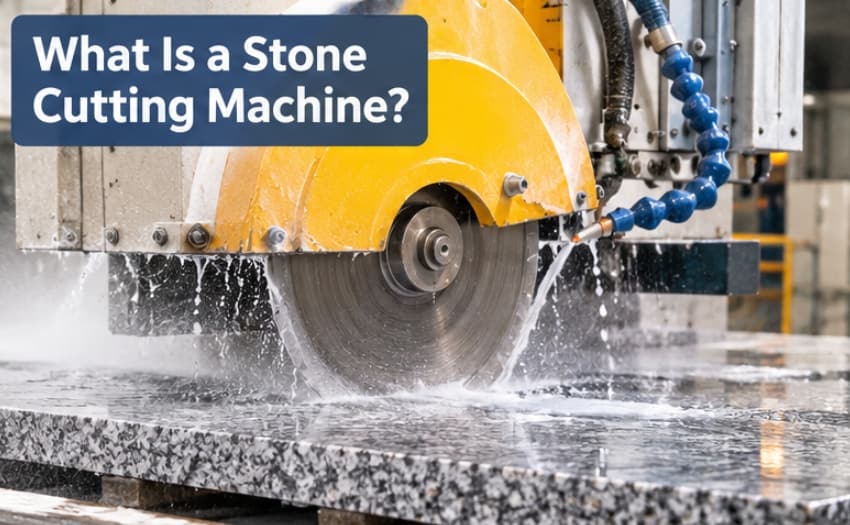
What Is a Stone Cutting Machine?
A stone cutting machine is an industrial system built to cut, shape, and profile hard stone materials into finished architectural products. Stone fabricators use this equipment to transform rough quarry blocks and raw slabs into precise tiles, pavers, and countertops.
Unlike handheld tools, an industrial stone cutting machine provides high mechanical rigidity and steady driving power. Most systems feature five core components:
Structural Frame: Absorbs heavy cutting vibrations.
Worktable: Secures heavy slabs firmly in place.
Spindle Motor: Delivers constant torque to the cutting tool.
Guide & Feed Rails: Directs straight linear movements along multiple axes.
Cooling Feed: Delivers continuous water to lubricate cuts and suppress dust.
Machine vs. Cutter vs. Saw
Fabricators often use these terms interchangeably, but they differ slightly in scope:
Stone Cutting Machine: Refers to large, stationary industrial installations such as bridge saws and CNC centers.
Stone Saw: Describes dedicated sawing machinery, including block saws or wire saws.
Stone Cutter: Commonly indicates portable, handheld power tools used for quick field trimming.
What Is a Stone Cutting Machine Used For?
Every fabrication workshop relies on a stone cutting machine to handle high-volume processing with tight tolerances.
1. Sizing Large Slabs
Fabricators use a heavy stone cutting machine to trim raw slabs into exact rectangular dimensions. Consequently, you can produce uniform floor tiles, stairs, and exterior cladding efficiently.
2. Fabricating Countertops and Edge Profiles
A modern stone cutting machine executes sink cutouts, 45-degree miter joints, and decorative edge bevels. Therefore, you can complete complex kitchen countertops without edge blowouts.
3. Cutting Natural and Engineered Materials
A versatile stone cutting machine processes diverse stone varieties:
Granite: Dense and abrasive; requires rigid sawing and high driving power.
Marble: Soft yet brittle; demands smooth cuts to prevent chipping.
Quartz: Dense and resin-rich; requires balanced spindle feed and ample water cooling.
Sintered Stone (Dekton, Porcelain): Extremely hard and brittle; requires specialized high-precision tooling.
What Are the Different Types of Stone Cutting Machines?
Choosing the right equipment depends directly on your shop volume and fabrication tasks.
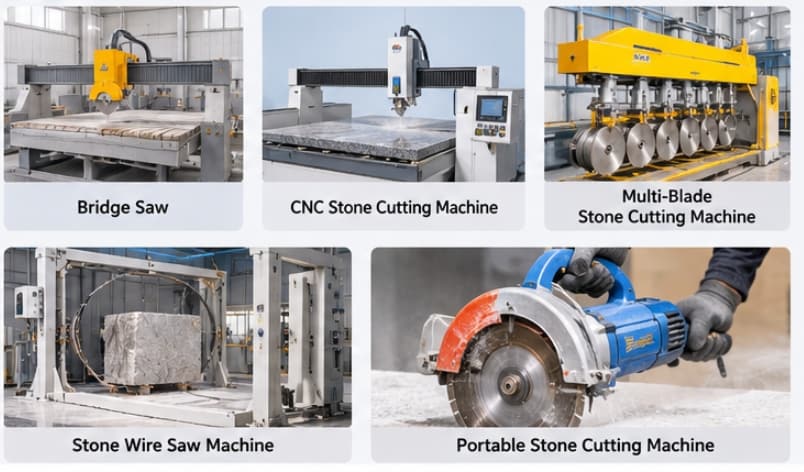
Bridge Saw
The bridge saw serves as the primary machine in most slab shops. The blade carriage travels along an elevated bridge beam, delivering fast, repeatable cuts across large slabs.
CNC Stone Cutting Machine
A CNC stone cutting machine runs computerized machining programs. As a result, you can execute complex contours, custom basins, and relief carvings with minimal manual intervention.
Multi-Blade Stone Cutting Machine
This machine mounts several parallel blades on a single shaft. Therefore, it slices an entire block into uniform slabs in a single run.
Stone Wire Saw Machine
Wire saws drive an endless high-tensile steel wire lined with diamond beads. Because the wire kerf is thin, it cuts massive stone blocks with very little material waste.
Portable Stone Cutter
Installers use portable units directly on the job site. These compact tools allow you to adjust backsplashes and trim floor tiles during final installation.
How Does a Stone Cutting Machine Work?
A stone cutting machine does not slice through stone like a metal saw cuts timber. Instead, it grinds away stone minerals at the micro-level using super-abrasive diamond crystals.
Step 1: Positioning and Securing the Slab
First, you place your stone slab onto the heavy worktable. Hydraulic clamps or rubber surfaces hold the slab securely. This prevents dangerous shifting during the cut.
Step 2: Selecting the Diamond Tool
Next, you match your tooling to the material hardness. Most automated machinery relies on premium diamond saw blades. Industrial diamond grits bonded in a metal matrix perform the actual cutting action through abrasive grinding.
Step 3: Executing the Programmed Cut
The machine motor spins the spindle between 1,400 and 2,800 RPM. Meanwhile, the mechanized bridge advances the cutting head smoothly along the cut line.
Step 4: Cooling and Flushing Slurry
During operation, dedicated nozzles flood the contact point with water. This fluid performs three crucial jobs:
It cools the blade core to avoid thermal warping.
It washes away abrasive stone slurry immediately.
It captures toxic crystalline silica dust, protecting your operators.
How to Choose the Right Blade for Your Stone Cutting Machine
Even the most powerful stone cutting machine fails without the correct diamond blade. Use this step-by-step checklist to match your blade to your job.
1. Match the Metal Bond to Stone Hardness
Diamond blade segments use metal bond powders to hold diamond grit. Always follow the rule of opposites:
For Hard Stone (Granite, Quartzite): Choose a soft metal bond. The bond matrix erodes easily, exposing fresh, sharp diamond crystals continuously.
For Abrasive Stone (Sandstone, Limestone): Choose a hard metal bond. The durable matrix resists premature erosion and extends tool life.
2. Choose the Best Rim Configuration
Segmented Blades: Deliver aggressive cuts and fast slurry evacuation on bridge saws.
Turbo Rim Blades: Offer fast cutting speeds and cleaner edges on portable cutters.
Continuous Rim Blades: Ensure chip-free cuts on delicate marble, porcelain, and sintered slabs.
3. Check Machine Spindle Compatibility
Always confirm your machine specs before ordering tooling:
Match your machine arbor bore size precisely (e.g., 50mm or 60mm).
Verify that the blade's rated RPM meets or exceeds your motor output.
Inspect flange diameters to prevent blade deflection during deep cuts.
Conclusion
A reliable stone cutting machine drives your workshop productivity. However, your cutting quality, feed speed, and tooling costs depend directly on pairing that equipment with professional diamond tools.
At Z-LION Diamond Technology, we manufacture industrial diamond saw blades, diamond wire saws, and CNC tooling tailored to your machinery and stone types. As an experienced manufacturer, we provide custom bond formulations for global fabricators.
Need cleaner cuts and longer blade life for your equipment?Consult Our Experts or request a customized quote for your shop today.
Frequently Asked Questions
What materials can a stone cutting machine cut?
A heavy-duty stone cutting machine cuts granite, marble, quartz, limestone, quartzite, and ultra-compact porcelain slabs.
Why do stone cutting machines use diamond blades?
Stone contains hard silica minerals that quickly destroy carbide teeth. Diamond provides unmatched hardness, allowing the blade to grind through hard stone without premature wear.
What is the difference between wet and dry stone cutting?
Wet cutting uses water to cool the blade, extend tool life, and eliminate hazardous silica dust. In contrast, dry cutting relies on ambient air and is limited to quick field touch-ups.
How do I prevent chipping on brittle stone?
Use a continuous rim blade, reduce entry and exit feed speeds, and ensure continuous high-pressure water flow directly onto the cut zone.