English
 Português
 русский
 Chinese
 French
 Japanese
 Spanish

How to Determine the Quality of a Saw Blade
2026-11-06 15:45:09
admin
When processing stone, you must know how to determine the quality of a saw blade. Relying only on price will cost you money. Therefore, you need a comprehensive evaluation method. Specifically, you must assess diamond quality, manufacturing precision, and actual cutting performance.
In this guide, we will focus on diamond cutting blades. First, you will learn what makes a good tool. Next, you will discover how to inspect products before buying. Ultimately, this knowledge ensures your stone fabrication remains highly profitable.
What Makes a High-Quality Diamond Saw Blade?
To fully understand how to determine the quality of a saw blade, you must examine its core components. Every high-quality tool requires precise engineering.
Diamond Quality and Distribution
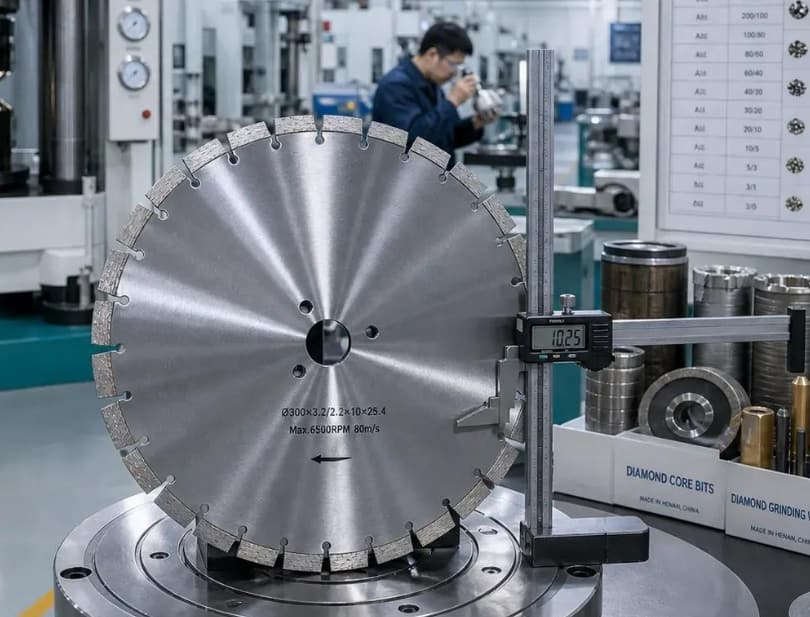
Manufacturers use synthetic diamonds for stone cutting. First, look at the diamond grit size and concentration. High-quality blades feature strong, sharp diamond crystals. Furthermore, the factory must distribute these diamonds evenly within the segment. Consequently, an even distribution ensures consistent cutting efficiency.
Bond Quality and Segment Composition
The metal bond holds the diamonds in place. Therefore, bond hardness is critical. A soft bond works best for hard stone like granite. In contrast, a hard bond suits soft abrasive materials like asphalt. A quality blade always features a bond specifically formulated for your target material.
Segment Manufacturing and Welding Quality
Factories attach segments to the steel core using laser welding or high-frequency brazing. You must check this connection. Strong welding prevents segments from flying off during high-speed rotation. As a result, safe operation depends directly on this manufacturing step.
Steel Core Quality
The steel core dictates blade stability. Top-tier manufacturers use tensioned, heat-treated steel. This premium steel prevents the blade from wobbling or warping under extreme heat. Therefore, a flat, rigid core guarantees straight cuts.
Actionable Checklist: How to Inspect a Saw Blade Before Buying
You cannot always test a blade before purchasing. However, you can perform a strict visual inspection. Use this actionable checklist to determine the quality of a saw blade before you buy:
Check Segment Uniformity: Look at the diamond segments. They must have identical heights and widths.
Inspect the Weld Lines: The joint between the segment and the core must look clean and continuous.
Verify the Steel Core: Hold the blade up to the light. The core must be perfectly flat with no visible cracks.
Confirm Specifications: Ensure the RPM rating, arbor size, and wet/dry application match your cutting machine.
How to Evaluate Performance During Cutting
Visual checks provide a good baseline. However, you must observe the tool in action. Understanding how to determine the quality of a saw blade requires real-world performance testing.
Cutting Speed and Efficiency
A premium blade cuts fast and smoothly. It requires very little pushing force. Conversely, a poor blade will struggle to penetrate the stone. If the blade glazes over and stops cutting, the bond quality is likely incorrect.
Cutting Quality and Stability
Next, examine the finished stone edge. A quality tool leaves a clean, straight cut. It does not chip or break the stone edges. Furthermore, the blade must not vibrate abnormally while spinning.
Wear Resistance and Service Life
Finally, track how long the blade lasts. Premium blades wear down slowly and evenly. If the segments wear out too fast, you lose money. Therefore, balancing cutting speed with lifespan defines true quality.
How to Choose the Right Blade for Your Stone Project
Understanding how to determine the quality of a saw blade ultimately helps you make better purchasing decisions. Always align the tool with your specific business needs.
Match the Blade to the Stone
Never use a universal blade for specialized work. For example, granite requires different diamond concentrations than marble. Dekton and sintered stone demand extremely precise, specialized bonds. Therefore, always buy a blade engineered for your exact material.
Consider the Overall Cutting Cost
Do not judge a blade by its upfront purchase price. Instead, calculate the cost per meter cut. A cheap blade that wears out quickly costs more in the long run. In addition, frequent blade changes waste valuable labor time.
Get Expert Solutions from Z-LION
At Z-LION, we manufacture highly efficient, precise, and durable diamond tools. As a listed B2B enterprise in China, we provide end-to-end solutions for stone fabricators worldwide. Furthermore, we offer custom OEM/ODM services tailored to your specific machines and stone hardness.
Are you looking for a reliable factory partner? Consult our experts today to request a quote or view specific product specifications for your next project.
Conclusion
In summary, learning how to determine the quality of a saw blade protects your business from costly downtime. Always inspect the diamond segments, verify the steel core, and monitor the actual cutting efficiency. By following these guidelines, you will secure high-quality tools that keep your stone fabrication process efficient, precise, and profitable.
Frequently Asked Questions
How to determine the quality of a saw blade based on price?
Price is an indicator, but not the rule. Generally, extreme cheapness means low diamond concentration and poor steel. However, the best value comes from matching the blade's cost-per-cut to your production needs.
How can you tell if a diamond saw blade is worn out?
You should replace the blade when the diamond segments wear down to the steel core. Additionally, if the blade stops cutting entirely despite being dressed, it has reached its end of life.
Can one diamond saw blade cut different types of stone?
Yes, some general-purpose blades exist. However, they compromise on speed and lifespan. For professional fabrication, you should always use material-specific blades.
Does blade thickness affect cutting performance?
Yes. Thicker blades offer more stability for deep cuts. In contrast, thinner blades remove less material, cut faster, and reduce stone waste.