English
 Português
 русский
 Chinese
 French
 Japanese
 Spanish

High Grit vs Low Grit Diamond Tools: A Guide for Stone Grinding and Polishing
2026-08-10 15:00:57
admin
Achieving a flawless finish on stone surfaces requires precision, expertise, and the right equipment. Specifically, you must understand the differences between high grit vs low grit diamond tools to maximize your project efficiency. If you choose the wrong abrasive, you risk damaging expensive materials or wasting hours on inefficient labor. Conversely, selecting the correct grit sequence guarantees a professional, mirror-like finish. By using reliable professional diamond polishing pads, you can confidently tackle any stone fabrication task. This guide will walk you through the exact specifications, applications, and best practices for proper diamond tool grit selection.
What Does Grit Mean in Diamond Tools?
Before you start grinding, you must understand how manufacturers measure abrasive strength. Grit refers to the physical size of the synthetic diamond particles embedded in the tool's bonding matrix. Manufacturers grade these particles using a standard mesh system.
Understanding Diamond Tool Grit Numbers
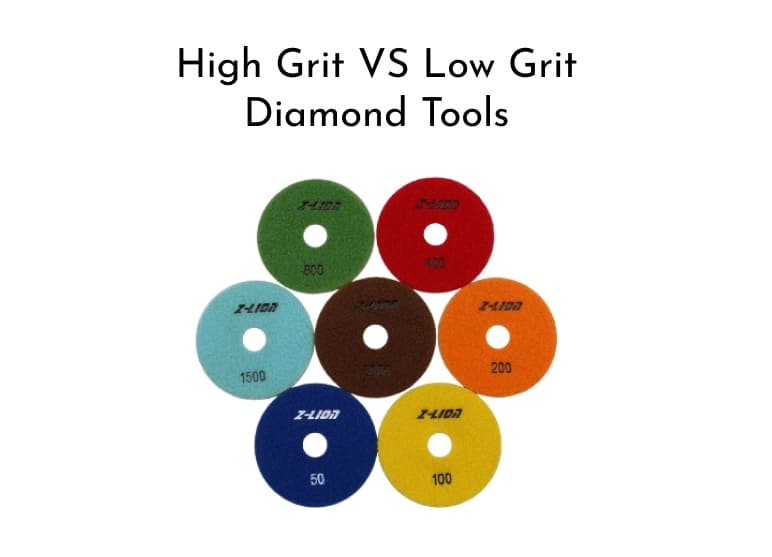
You will see numbers stamped on your tools, such as 30, 100, or 3000. These numbers represent the diamond abrasive grit sizes. A lower number indicates larger, coarser diamond particles. For example, a 30-grit pad contains large, aggressive diamonds. In contrast, a higher number indicates much smaller, finer diamond particles. Therefore, a 3000-grit pad feels almost smooth to the touch. You must sequence these numbers correctly to achieve a high-gloss polish.
How Grit Size Affects Stone Grinding Performance
Grit size directly dictates how a tool interacts with hard surfaces. Low grit numbers bite deeply into the stone. As a result, they remove material quickly but leave visible scratches. High grit numbers barely penetrate the surface. Consequently, they smooth out existing scratches and build surface gloss. Proper diamond tool grit selection ensures you transition smoothly from aggressive cutting to delicate polishing without leaving residual damage.
High Grit vs Low Grit Diamond Tools: Key Differences
To help you evaluate your options, we have compiled a quick reference comparison table. This diamond tool grit chart breaks down the critical differences between coarse and fine abrasives.
Diamond Grit Comparison Table
Feature Low Grit Tools (e.g., 16 - 100) High Grit Tools (e.g., 400 - 3000) Particle Size Large and coarse Small and fine Cutting Action Highly aggressive Gentle and smoothing Surface Finish Leaves deep scratches Creates a high-gloss finish Primary Goal Fast material removal Final polishing and shine
Low Grit Diamond Tools for Fast Material Removal
You should reach for coarse grit diamond tools when you need raw cutting power. These tools feature larger diamond particles held firmly in a robust metal or hard resin bond. Because of their aggressive cutting action, they tear through hard materials rapidly. However, this power results in a deeper scratch pattern on the stone surface.
These low grit options are ideal for heavy-duty preparation tasks. For instance, you will use them for removing scratches, leveling uneven stone surfaces, and shaping stone edges during the initial grinding stage. Specifically, contractors rely on them for heavy marble surface repair, aggressive granite edge grinding, and rapid quartz countertop modification.
High Grit Diamond Tools for Fine Finishing and Polishing
As you progress through your project, you must switch to fine grit diamond tools. These tools utilize much smaller diamond particles. Because the abrasives are micro-sized, they deliver a significantly smoother surface finish. Furthermore, they provide better gloss development on dense materials.
You will use these tools exclusively for the final stages of your project. Therefore, they excel at stone honing, final polishing, and restoring shine to dull surfaces. Professionals consistently use high grit options to achieve a factory-like polish on marble, granite, and quartz installations.
High Grit vs Low Grit Diamond Tools: Which One Should You Use?
Choosing between high grit vs low grit diamond tools depends entirely on your current project stage. Use the following actionable checklist to match your application with the correct tool type.
Choose Low Grit Diamond Tools When You Need to Remove Material
You must select aggressive, low grit diamond tools whenever you face heavy material removal challenges. These tools will save you hours of unnecessary labor.
Use Low Grit (16–100) for these scenarios:
Eliminating deep scratches from improper handling or heavy wear.
Leveling severely uneven surfaces on freshly installed stone floors.
Profiling and shaping rough stone edges before finishing.
Stripping stubborn adhesive residue, epoxy, or old coatings.
Recommended Tools:To tackle these tough jobs efficiently, equip your grinders with heavy-duty diamond flap discs. Additionally, diamond grinding discs (cup wheels) and coarse diamond sanding tools will deliver the rapid stock removal you require.
Choose High Grit Diamond Tools When You Need a Smooth Finish
Once you complete the heavy shaping, you must transition to high grit diamond tools. Skipping straight to high grits will ruin your pads, while stopping too early leaves the stone looking dull.
Use High Grit (400–3000) for these scenarios:
Polishing countertops to a high-gloss, mirror-like finish.
Restoring marble gloss on older, lightly worn floors.
Achieving smooth edges on intricate stone profiles.
Recommended Tools:For flawless finishing, you should utilize premium diamond polishing pads. Furthermore, fine diamond sanding discs and specialized resin bonded diamond polishing tools will help you achieve the perfect luster.
Conclusion
Understanding high grit vs low grit diamond tools is the foundation of professional stone fabrication. First, you must use coarse tools to shape the stone and remove heavy damage. Next, you must systematically work through the higher grits to build a brilliant, scratch-free shine. By following a strict grit sequence, you will improve your project efficiency, extend the lifespan of your abrasives, and deliver superior results to your clients.
As a leading source for professional diamond abrasives, Z-LION Diamond Technology provides highly customized solutions for global contractors and distributors. Whether you are cutting Dekton, leveling concrete, or polishing granite, we manufacture the precise tools you need. Please contact our experts to request a custom quote on OEM/ODM manufacturing or bulk orders today.
FAQs
Is higher grit better for diamond tools?
No, a higher grit is not inherently better; it simply serves a different purpose. You use high grit tools for polishing and achieving a smooth finish, whereas you must use lower grits for aggressive material removal and shaping.
Does lower grit remove more material?
Yes, lower grit tools contain larger, more aggressive diamond particles. Consequently, they cut deeper into the stone and remove significantly more material at a much faster rate than higher grits.
What grit diamond tool should I use for marble polishing?
For marble polishing, you should typically start with a 400-grit pad to hone the surface. Next, you will progress sequentially through 800, 1500, and 3000-grit diamond pads to achieve a high-gloss mirror finish.
What grit diamond tool should I use for granite grinding?
To grind rough granite or remove deep scratches, you should start with low grit metal-bonded tools, such as 30 or 50 grit. Afterward, you can transition to 100 and 200-grit tools to smooth out the initial heavy scratches before polishing.