English
 Português
 русский
 Chinese
 French
 Japanese
 Spanish

Countertop Edge Profiles: Complete Guide to Styles, Selection, and Tools
2026-06-05 15:53:25
admin
Choosing the right countertop edge profiles is a critical decision for any stone fabrication or commercial installation project. These designs shape both the visual appeal and the long-term durability of the surface. Consequently, you must understand how countertop edge profiles affect durability. Fortunately, selecting the correct option ensures success. If you are preparing to cut materials before profiling, you can check our professional diamond cutting blades to achieve clean initial cuts.
What Are Countertop Edge Profiles?
In the stone industry, countertop edge profiles refer to the specific shape given to the exposed borders of a countertop. Fabricators grind and polish these edges to transition the top surface to the vertical side. Consequently, these profiles protect the material from chipping while enhancing safety.
Why Countertop Edge Profiles Matter
The edge profile defines how the countertop interacts with light, space, and daily traffic. If you select the wrong shape, you risk early chipping. Alternatively, the right choice ensures the countertop endures high-impact use. Therefore, professionals must understand how countertop edge profiles behave under stress.
Decorative Value vs Functional Value
Indeed, countertop edge profiles offer both visual style and practical protection. For example, rounded edges deflect impacts better than sharp, straight edges. Conversely, simple straight edges maintain a clean, modern aesthetic. Thus, balancing beauty and durability remains a primary goal for fabricators when selecting countertop edge profiles.
Most Popular Countertop Edge Profiles
To satisfy clients, fabricators must offer a diverse range of countertop edge profiles. Below, we examine the most common countertop edge styles and countertop edge designs used in the industry today.
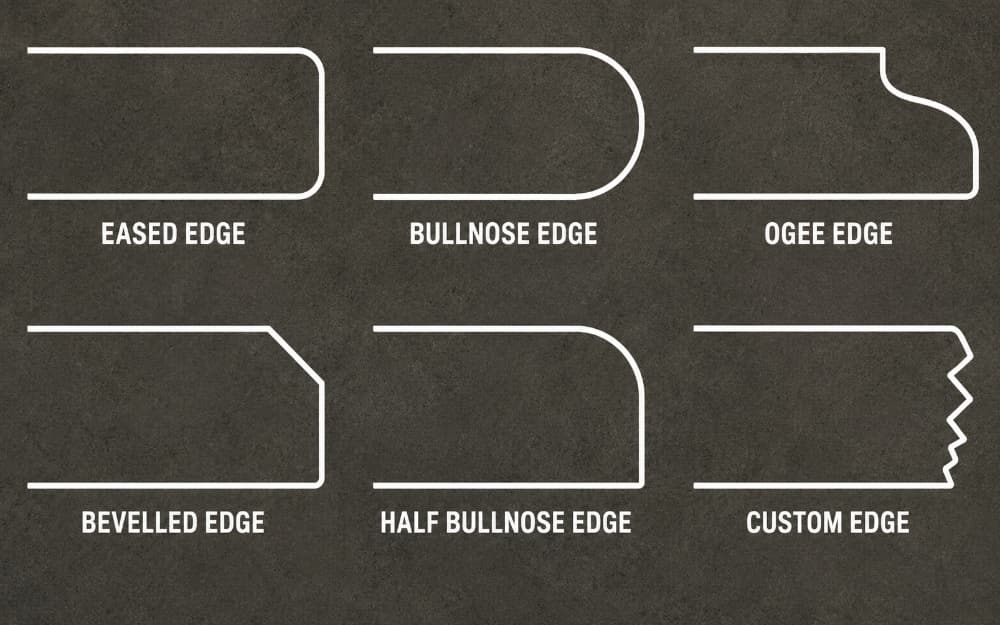
Eased Edge
The eased edge remains one of the most common countertop edge profiles. This profile maintains a clean, square appearance but removes sharp, hazardous corners. Therefore, it fits modern and minimalist kitchens.
Pencil Edge
In contrast, pencil-style offer a slightly softer roundness. It mimics the soft radius of a pencil. Because the rounding is minimal, it preserves the sleek lines of the countertop while protecting users.
Beveled Edge
Beveled countertop edge designs use an angled cut, typically at 45 degrees. This shape creates a distinct, reflective facet along the border. Therefore, it adds depth and structure to the room.
Bullnose Edge
Bullnose countertop edge profiles provide a fully rounded edge on both the top and bottom. This design creates a smooth, semi-circular profile. Because there are no sharp angles, it offers exceptional safety.
Half Bullnose Edge
Half bullnose countertop edge shapes curve gently on top but remain flat on the bottom. Consequently, it allows water spills to run off without instantly dripping onto cabinets.
Ogee Edge
Ogee countertop edge profiles represent classic traditional luxury with an S-shaped curve. It creates beautiful shadows that elevate custom stonework. However, it requires highly precise diamond tooling to fabricate.
Mitered Edge
Mitered profiles create the illusion of a single, massive slab. This design joins two pieces of stone cut at 45-degree angles. Thus, it works beautifully for thick waterfall designs.
Specialty Edge Designs
Elaborate countertop edge profiles like Dupont require specialized tooling and multi-step processing. Fabricators must use specialized profile wheels and precise polishing stages to prevent material fracturing.
Here is a quick reference table to compare these common profiles:
| Profile Name | Visual Style | Fabrication Complexity | Best Material Matches | Safety Rating |
|---|---|---|---|---|
| Eased | Modern / Minimalist | Low | Quartz, Granite, Marble | Medium |
| Beveled | Transitional | Medium | Granite, Sintered Stone | Medium |
| Bullnose | Classic / Soft | Medium | Granite, Marble, Concrete | High |
| Ogee | Traditional / Ornate | High | Marble, Granite | High |
| Mitered | Seamless / Luxury | High | Quartz, Dekton, Porcelain | Low |
How to Choose the Right Countertop Edge Profiles
Selecting the correct countertop edge profiles requires a balance of aesthetics, material characteristics, and budget. Here is how you can guide your clients through the selection process.
Choose by Design Style
Modern kitchens favor clean, linear countertop edge shapes like eased or mitered profiles. In contrast, traditional designs benefit from the intricate curves of ogee or Dupont profiles. Match the edge to the cabinetry style for a unified look.
Choose by Countertop Material
Different materials exhibit unique physical properties that dictate the best countertop edge styles:
Granite: Highly durable. It handles complex profiles like bullnose and ogee without breaking.
Marble: Softer and prone to chipping. Avoid sharp corners; choose rounded profiles instead.
Quartz: Strong and engineered. It works with almost any edge, especially eased or beveled designs.
Sintered stone / porcelain / Dekton: Extremely hard but brittle. Stick to eased or mitered edges to prevent edge chipping.
Choose by Maintenance and Safety
Homeowners prioritize safe countertop edge profiles over sharp edges. Rounded edges like bullnose are easy to clean. Conversely, complex profiles like ogee can collect dust and grease along their grooves.
Choose by Fabrication Complexity and Budget
Complex profiles cost more to fabricate due to tool wear and processing time. Simple cuts require less time. Consequently, eased edges cost less. Elaborate curves demand multiple passes with profiling tools.
What Tools Are Used to Fabricate Countertop Edge Profiles?
Creating countertop edge profiles requires specialized diamond tooling to achieve professional finishes. Each step of the shaping and polishing process demands specific equipment to avoid material damage.
Profiling Wheels and Router Tools
First, you need to shape the edge. Our high-precision diamond profiling wheels match industry-standard routers. These wheels grind hard stone into the exact profile shape.
Diamond Polishing Pads
Next, you must restore the stone's original luster. Professionals use wet or dry polishing pads in sequential grits. These tools prevent burning on sensitive surfaces like quartz.
Diamond Hand Pads
For tight corners, manual touch-ups, and on-site adjustments, you should use specialized hand pads. They allow fabricators to clean up micro-chips and smooth sharp edges without heavy machinery.
Checklist for Fabricating Countertop Edge Profiles:
Check Water Flow: Is there sufficient water cooling to prevent burning?
Inspect Tool Wear: Are the profile wheels worn unevenly? Replace them to prevent wavy edges.
Verify Speed (RPM): Are you running the polishing pads at the correct RPM?
Grit Progression: Did you skip a grit? Never skip more than one grit step.
Selecting the Ideal Countertop Edge Profiles for Your Project
In summary, your choice of countertop edge profiles defines the success of your installation. Whether you are installing classic granite or modern sintered stone, using premium tooling ensures clean results. If you need reliable equipment for your next project, you can browse our high-performance diamond polishing pads to achieve an excellent finish. Please contact our team at Z-LION today for expert assistance.
FAQs
Which of the countertop edge profiles is most popular?
The eased edge is the most popular option. Its clean, modern look pairs well with almost any kitchen style, and it is cost-effective to produce.
Which countertop edge profile is easiest to clean?
Yes. The bullnose and eased edges are the easiest to clean. They do not have tight crevices or intricate grooves where dirt and grease can build up.
Which edge profile is best for quartz countertops?
Eased, beveled, and pencil profiles are excellent for quartz. These profiles highlight the material's clean composition while minimizing the risk of chipping.
Are rounded countertop edges safer?
Yes. Rounded edges like bullnose and half bullnose significantly reduce impact injuries. Therefore, they are ideal for households with children or busy commercial venues.
What tools are needed to polish countertop edges?
Fabricators need diamond profiling wheels to shape the profile, followed by a series of diamond polishing pads (from coarse to fine grit) to restore the shine. Diamond hand pads are also useful for detail work.