English
 Português
 русский
 Chinese
 French
 Japanese
 Spanish

Installer's Guide: How to Safely Enlarge a Hole in Granite Countertops
2026-04-30 15:00:39
admin
When a new faucet or sink requires you to enlarge a hole in a granite countertop, this is a common yet high-risk task. A single mistake in tool selection or execution can cause cracks, leading to costly replacement. This work requires precision, control, and professional-grade equipment. As experts in diamond tools, we know success depends on the right process. This guide provides a contractor-level approach to help you achieve clean, factory-quality results using our professional Z-LION diamond grinding tools.
This guide walks you through the process: starting with a critical assessment, selecting the right tools, and following step-by-step instructions to ensure accurate results.

Step 1: Critical Planning & Assessment
Before touching the stone, conduct a proper assessment. Rushing is a leading cause of costly mistakes. You need to thoroughly evaluate the project to identify the risks and requirements involved in enlarging holes for granite countertop installation.
Your 5-Point Professional Checklist:
Define Your Goal: Obtain the exact specifications or template and confirm the required diameter. Is this a simple faucet hole enlargement (e.g., from 1 1/4" to 1 3/8") or a more complex sink modification?
Analyze the Location: Measure the distance from the hole to the nearest edge, seam, or cutout. Cutting within 2–3 inches (5–7.5 cm) of an edge significantly increases the risk of cracking.
Inspect the Stone: Check for natural cracks, veins, or previous repairs. These are weak points that may fail under pressure.
Measure the Thickness: Confirm whether the countertop is 2 cm (3/4") or 3 cm (1 1/4") thick granite. Thickness directly affects the amount of grinding required and the time needed.
Clear the Workspace: Ensure a safe workspace below and remove pipes, wires, and obstacles.
The Big Decision: Should You DIY or Call a Fabricator
Whether to do it yourself or hire a professional is a critical decision. Consider the risks, your experience, and the value of the countertop.
If the enlargement is minimal (e.g., less than 1/4 inch), the hole is far from edges, and you have experience using a variable-speed angle grinder, DIY may be possible. However, this is not a job for standard hardware store tools.
We recommend hiring a professional in the following cases:
The granite is rare or expensive
The hole is close to an edge, seam, or cutout
Reshaping is required, not just enlarging
You lack experience or proper safety equipment
Whichever path you choose, success depends on using the right tools. Amateur tools often produce poor results and may cause serious damage. Professionals can precisely enlarge existing holes in granite because they use tools designed for control and accuracy.
The Professional's Tool of Choice: The Diamond Drum Wheel
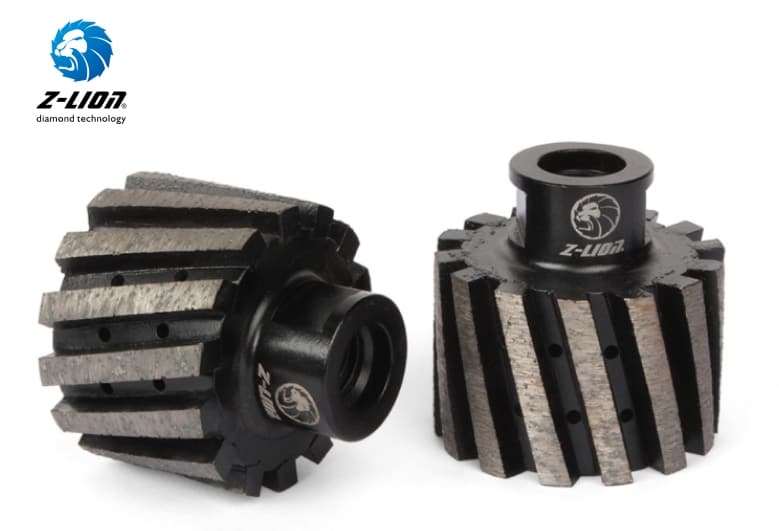
When you need to enlarge a hole in a granite countertop, a diamond drum wheel is the best choice. It is a cylinder coated with diamonds and mounted on a variable-speed angle grinder. Unlike sharp cutting tools, a drum wheel removes material smoothly and with control.
Here is how it compares to other methods.
| Tool Type | Application | Risk Factor | Finish Quality |
|---|---|---|---|
| Diamond Drum Wheel | Grinding and enlarging existing holes | Low | Excellent: Smooth, even, ready for polish. |
| Diamond Hole Saw | Drilling new holes | Very High: No center guide, will skip and chip the surface. | Poor: Uncontrollable, high chance of chipping. |
| Grinder with Blade | Straight cutting and shaping | High: Very difficult to create a perfect circle. | Poor: Results in a jagged, uneven finish. |
Introducing the Z-LION Diamond Drum Wheel
At Z-LION, we build tools for professionals who cannot afford mistakes. Our diamond drum wheels are designed for this application.
Precision Control: The drum wheel allows you to remove stone with the precision of an eraser. You can approach the marking line slowly to achieve a perfect fit while avoiding overcutting.
Chip-Free Finish: Dense diamond layer ensures efficient grinding and smooth edges
Factory-Direct Durability: As a publicly traded company, we oversee the entire manufacturing process. Our tools are designed for daily use in professional workshops, delivering exceptional longevity and performance on granite, quartz, marble, and engineered stone.
Step-by-Step: How to Use a Diamond Drum Wheel Like a Pro
The correct process is as important as the right tools. Follow these steps to safely enlarge holes for sinks and faucets in granite.
Step 1: Safety First
Wear personal protective equipment (PPE), including a P100 or N95 respirator to protect against silica dust, safety goggles, and gloves.
Step 2: Prepare and Mark
Protect surrounding areas with plastic sheeting. Mark the new hole size clearly using a template.
Step 3: Set Up for Wet Grinding
Wet grinding is essential to suppress hazardous dust, cool the grinding drum, and extend its lifespan. Continuously apply small amounts of water during operation.
Step 4: The Grinding Process
Mount the Z-LION diamond drum wheel on a variable-speed grinder. Start at medium speed before contacting the stone. Gently press the drum against the inner edge, moving in a steady circular motion. Do not apply excessive pressure.
Step 5: Check and Finish
Stop regularly to clean slurry and check progress. Once the target line is reached, clean the hole. For a refined finish, use diamond polishing pads on the inner edge.
Partner with the Source for Your Fabrication Needs
Successfully enlarging holes in granite countertops depends on both technique and tools. At Z-LION, we provide both. As a factory-direct manufacturer, we offer not only products but complete solutions, including OEM/ODM customization to match your equipment and materials.
If you are a contractor, distributor, or processor seeking reliable diamond tools, our team is ready to assist. Contact us to discuss your needs or request a quote for our diamond drum wheels and related solutions.