English
 Português
 русский
 Chinese
 French
 Japanese
 Spanish

Differences Between Hollow Drills/Core Drills and Solid Drills/Blind Drills in Stone Processing
2025-12-12 09:07:33
admin
Drilling is a fundamental and crucial step in stone processing and installation. Depending on the specific requirements of the project, different types of drill bits are used, primarily including hollow drills (also known as core drills) and solid drills (or blind drills). These two types of drill bits differ significantly in structure, working principle, and application. Understanding these differences is essential to ensuring the efficiency and quality of stone drilling operations.
1. Hollow Drill: A “Ring Cutting Expert” Specializing in Large Diameter Holes
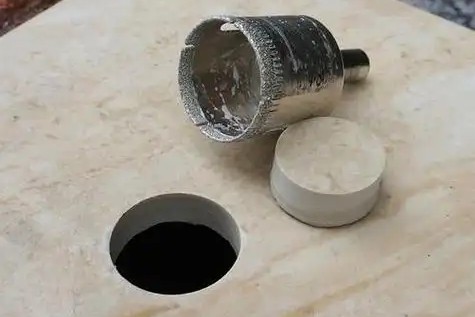
The hollow drill bit features a cylindrical design with a diamond cutting head embedded in the bottom. This design allows it to efficiently drill large holes in stone.
Working principle:
A hollow drill doesn’t grind the entire stone inside the hole. Instead, it uses high-speed rotation and a compass-like cutting head to make a circular cut. This cutting method only creates a circular groove, effectively separating the cylindrical stone core from the middle and securing it inside the drill rod. Once the hole is drilled, the stone core can be easily removed.
Core advantages:
High efficiency and labor saving: Because hollow drill bits only drill circular areas, the amount of manpower required is significantly reduced compared to grinding the entire hole. This efficiency is particularly advantageous when drilling large-diameter holes (typically greater than 20 mm).
Large and precise hole diameter: Hollow drill bits can easily drill large holes ranging from tens to hundreds of millimeters, resulting in smooth and uniform cuts.
Excellent cooling effect: The hollow structure allows cooling water to flow directly into the cutting surface, effectively reducing temperature and removing debris. This cooling mechanism protects both the drill bit and the stone being processed.
Main application areas:
Hollow drills are primarily used for drilling large holes through walls and boards. Common applications include:
Open the pipe hole
Water pipe and electrical wiring holes
Ventilation holes
Anchor wire light holes on the stone wall
2. Solid Drill: A Pioneer in Flexible and Precise Spot Drilling
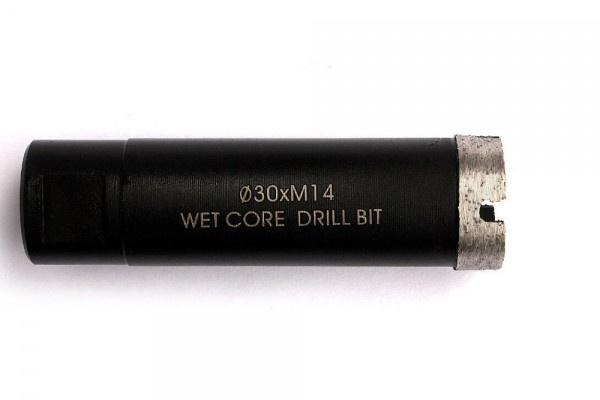
Solid drill bits, also known as blind drills, are characterized by their solid cylindrical design and lack of a hollow core. They are typically used for drilling smaller holes in stone.
Working principle:
The working principle of an integral drilling rig is as follows: the drill bit tip is positioned, and the entire drill bit is moved forward to grind all the rocks in the borehole into powder, which is then discharged. This method achieves “full-section cutting”.
Core advantages:
Flexible and portable: Solid drill bits are small in size and have low starting torque, making them suitable for use in hand drills and very flexible in operation.
Suitable for small holes: Solid drill bits excel at drilling small holes (typically less than 12 mm in diameter), making them ideal for pre-drilling holes to install screws and anchors.
Low cost: Small solid drill bits typically have lower manufacturing and purchase costs than hollow drill bits of the same size, making them an economical option.
Main application areas:
Solid drill bits are typically used for:
Pre-drilling holes for fixing components
Install hooks
Create a faucet interface
Suitable for general drilling of stone, no large hole diameter required.
Summary and Selection Principles
When choosing between hollow and solid drill bits, please consider the following guidelines:
Drilling large holes (>Φ 20mm): Always choose hollow drill bits. They are efficient and economical, making them ideal for drilling large diameter holes.
Drilling small holes (<Φ 12mm): Solid drill bits are the preferred choice due to their flexibility, speed, and cost-effectiveness.
Medium hole diameter (Φ 12mm to 20mm): This can be selected based on available tools and specific needs. However, trends indicate that the larger the hole diameter, the more pronounced the advantages of a hollow drill become.
Other notes
Regardless of the type of drill bit used, when machining hard materials such as granite or quartz, always choose drill bits with electroplated or sintered diamond inserts. Furthermore, continuous water cooling is crucial to prevent the drill bit from overheating, which can damage the bit and compromise the integrity of the stone.
In summary, understanding the differences between hollow and solid drill bits, their respective advantages and applications, is crucial for achieving optimal results in stone drilling projects. By selecting the appropriate drill bit type based on the hole diameter and the material being drilled, operators can ensure work efficiency, quality, and cost-effectiveness.