English
 Português
 русский
 Chinese
 French
 Japanese
 Spanish

Types of Diamond Wire Saws: A Comprehensive Overview
2025-08-01 11:16:32
admin
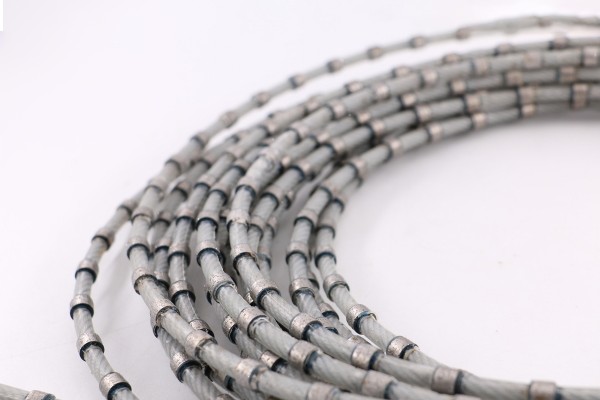
In the construction and manufacturing sectors, the need for precision cutting tools has never been greater. One of the most advanced options available today is the diamond wire saw, a specialized cutting tool that utilizes diamond beads mounted on a high-strength steel cable. This innovative tool is primarily used to cut through hard materials such as reinforced concrete and stone, making it an indispensable tool for a variety of industries such as construction, mining, and stone processing. This article delves into the core structure, working principles, and types of diamond wire saws.
Core Structure
A diamond wire saw consists of three main components:
High-strength steel wire rope: The steel wire rope is the skeleton of the diamond wire saw, providing the strength and flexibility required for cutting. It is designed to withstand the high tension and stress generated during the cutting process.
Diamond beads: These diamond beads are set in an alloy matrix and are the cutting elements of the wire saw. With a Mohs hardness of 10, diamond is the hardest material known, so it is very effective in cutting hard surfaces.
Connection mechanism: This component secures the diamond beads to the wire rope, ensuring it remains fixed during operation. The connection must be strong to withstand the forces generated during cutting.
The cutting action is achieved by driving the wire rope to rotate at high speed through a driving device, so that the diamond beads engage with the material to be cut.
How Does It Work?
The working principle of a diamond wire saw is simple and effective:
Micro-scratches: When the diamond particles come into contact with the material, they create micro-scratches on the surface. This initial contact is critical to start the cutting process.
Fatigue fracture: The high frequency impact of the diamond beads causes fatigue fractures in the material along the grain boundaries. This process effectively weakens the material, making it easier to cut.
Cooling mechanism: To prevent thermal damage during cutting, we use cooling water. The cooling water can reduce the temperature of the cutting surface to keep the temperature difference within 50°C. This cooling effect is essential to maintain the integrity of the diamond wire saw and the material being cut.
Types of Diamond Wire Saws
There are three main types of diamond wire saws: sintered beads, electroplated beads, and vacuum brazed beads. Each type has its own unique manufacturing technology, advantages and disadvantages, and applications.
1. Diamond sintered wire saw
Definition
Diamond sintered wire saw is a cutting tool formed by sintering diamond particles and metal binders (such as cobalt) at high temperature into beads, and then fixing the beads on wire ropes. This type of wire saw is the most traditional and most commonly used wire saw on the market, with a long history of production and application.
Advantages
Strong wear resistance: Sintered wire saws are known for their durability and are suitable for long-term operation.
Multi-layer diamond structure: This structure can extend the service life because multiple layers of diamonds are used for cutting.
Shortcoming
Low accuracy: It can be challenging to control the distribution of diamonds within the bead, which may affect cutting accuracy.
Insufficient efficiency: When cutting particularly hard materials, the efficiency may not meet the expected standards.
Cutting objects
Diamond sintered wire saws are ideal for materials that require high wear resistance, such as granite, hard stone and reinforced concrete.
2. Electroplated diamond wire saw
Definition
Electroplated diamond wire saw is a tool that wraps and fixes diamond particles on a steel wire rope through an electroplated nickel layer to form a single layer of diamond beads. This method is simpler and more economical for producing beads with smaller diameters.
Advantages
Simple process: The manufacturing process is simple, suitable for the production of small diameter beads.
Fast initial cutting speed: The electroplated saw can achieve fast cutting speed at the beginning of operation.
Shortcoming
Easy to fall off: Diamond particles are easy to fall off, resulting in a shortened tool life.
Thin coating: The diamond layer is thinner, the wear resistance is poorer, and it is not suitable for cutting hard materials.
Cutting objects
Electroplated diamond wire saws are best suited for cutting softer stones such as marble, where the cutting requirements are less stringent.
3. Brazing wire saw
Definition
A brazed wire saw is a single-layer diamond tool that uses an active brazing material (such as nickel-chromium) to form a chemical metallurgical bond between the diamond and the substrate. This method provides a strong connection, thereby improving cutting performance.
Advantages
High cutting efficiency: The diamond blade height can reach 70%, which can achieve efficient cutting.
Good heat dissipation: This property makes brazed wire saws suitable for high-speed cutting applications.
Shortcoming
Strict process requirements: The manufacturing process is more complicated and more costly than other types.
Single-layer diamond: The saw needs to be replaced after long-term wear because it does not have the multi-layer structure of a sintered saw.
Cutting objects
Brazed wire saws can effectively cut through hard materials such as granite, concrete, and rebar, making them versatile tools in the construction and manufacturing industries.
Comparison summary
Diamond wire saws are key cutting tools used in a wide range of industries. Here is a comparison summary of the three types:
Diamond sintered wire saw: Most popular due to its long life, durability, and perfect for hard materials.
Electroplated wire saw: Suitable for softer materials, but has shorter life and lower wear resistance.
Brazed wire saw: Increasingly popular due to its efficiency and heat dissipation, especially in hard material applications.
With the advancement of wire technology, the size of diamond wire saws has become smaller and smaller while maintaining strong pulling force. The size of the cutting bead has also become smaller and smaller, from 7 mm to 4 mm or even smaller, to minimize cutting loss.
Future Trends
As the industry develops, diamond wire saws are expected to become smaller and more efficient. With continuous innovation aimed at improving cutting efficiency and sustainability, the future of diamond wire saw technology is promising.
In summary, understanding the different types of diamond wire saws and their applications is essential to choosing the right tool for your specific cutting needs. Each type has its own unique advantages and limitations, so users must carefully evaluate their needs.
label:
Diamond Wire Saw