English
 Português
 русский
 Chinese
 French
 Japanese
 Spanish

Flexible Diamond Polishing Pads vs Other Grinding Tools: What Are the Advantages?
2025-05-30 09:22:01
admin
When it comes to concrete grinding and surface preparation, the choice of grinding tools has a significant impact on work efficiency and quality. Among the many options, This article compares flexible diamond polishing pads with traditional grinding tools, focusing on their advantages and exploring the limitations of traditional methods. have become the first choice for many professionals. This article compares flexible diamond polishing pads with traditional grinding tools, focusing on their advantages and exploring the limitations of traditional methods.
Limitations of Traditional Grinding Tools
1. Sandpaper
Sandpaper is one of the most commonly used abrasive tools and features abrasive particles attached to a paper backing. While sandpaper is very effective for light sanding and finishing, it also has some limitations:
Short service life: Sandpaper wears out quickly, especially when used on harder materials or complex surfaces. This leads to frequent replacement, increased costs and extended downtime.
Dust generation: The grinding process using sandpaper generates a lot of dust, which can create a hazardous working environment and pose a risk to the operator's health.
Limited effectiveness: With harder materials, sandpaper may have difficulty achieving the desired effect, resulting in less efficient grinding.
2. Wire brush
Wire brushes are commonly used to remove rust, paint, and other surface contaminants. However, they also have significant disadvantages:
Not capable of fine grinding: Wire brushes excel at removing larger attachments but are not suited to fine grinding tasks, limiting their versatility.
Bristle deformation: Wire bristles are prone to deformation during use, resulting in weakened abrasive effect and uneven surface treatment.
Surface damage: Wire brushes can cause scratches and other damage to delicate or soft materials, which can negatively impact the final quality of the workpiece.
3. Grindstone
Grinding stones use abrasive particles to grind surfaces and are known for their uniform grinding effect. However, they also have their own limitations:
Large area inefficiency: When treating large surfaces, grinding stones are inefficient and require more time and effort to achieve the desired results.
Risk of surface damage: With softer materials, over-grinding with a stone can cause surface damage that compromises the integrity of the piece.
Moisture requirements: Grinding stones typically require water to stay moist during use, which adds complexity and can create a mess.
Special Advantages of Flexible Diamond Polishing Pads
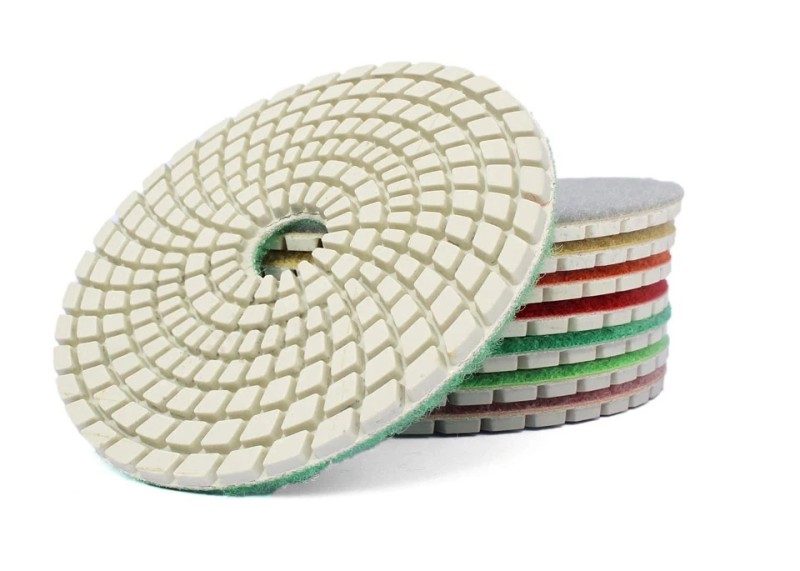
1. High efficiency grinding performance
One of the outstanding features of flexible diamond polishing pads is their efficient grinding performance. Diamond is one of the hardest substances in nature, far exceeding the hardness of traditional abrasive materials. This inherent hardness brings many advantages:
Multiple material compatibility: Flexible diamond polishing pads are suitable for grinding a variety of materials, including hard metals, stone, and even softer materials like wood. Its ability to quickly remove excess material makes it suitable for a variety of applications from heavy-duty grinding to fine polishing.
Simplify the process: Traditional polishing methods usually require the use of multiple sandpapers of different coarseness and fineness to achieve the desired polishing effect. This is time-consuming and inefficient. In contrast, flexible diamond polishing pads can seamlessly transition from coarse grinding to fine polishing in just one step. For example, when processing stainless steel products, these polishing pads can achieve a bright polishing effect without frequent abrasive changes, which significantly improves overall work efficiency.
Consistent results: The uniformity of the diamond grains in these pads ensures consistent grinding results, reducing the likelihood of surface defects and improving the quality of the finished product.
2. Good flexibility
Another major advantage of flexible diamond polishing pads is their excellent flexibility. This property enables them to adapt to the contours and shapes of various workpieces, bringing many benefits:
Enhanced surface conformity: Conventional grinding tools have difficulty conforming to irregular or curved surfaces, while flexible diamond polishing pads can easily bend and conform to the shape of the workpiece. This is particularly beneficial in applications such as automotive body repair where surfaces often have complex curves and contours.
Even sanding of complex shapes: The flexible diamond polishing pad conforms closely to the surface, ensuring that every corner and edge is polished evenly. This results in a smoother and flatter surface, which is essential to maintaining the beauty of the repair surface. Traditional sandpaper may leave uneven areas or fail to reach certain contours, resulting in a poor surface quality.
Reduces risk of damage: The flexibility of these polishing pads minimizes the risk of damaging delicate surfaces. Conventional abrasive tools can sometimes apply too much pressure or cause uneven wear, resulting in scratches or gouges. Flexible diamond polishing pads distribute pressure evenly, reducing the likelihood of surface damage.
3. Long life and high wear resistance
One of the outstanding features of flexible diamond polishing pads is their extremely long service life, which far exceeds that of conventional grinding tools. This advantage can be attributed to several factors:
a. Diamond has high hardness
Diamond is known to be one of the hardest substances in nature. This inherent hardness means that the abrasive particles in flexible diamond polishing pads wear very slowly, even over long periods of use. As a result, these pads retain their abrasive effect over time, making them ideal for demanding applications.
b. Reduce the frequency of replacement
Due to their durability, flexible diamond polishing pads need to be replaced much less frequently than traditional tools such as sandpaper and wire brushes. For example, in a stone processing plant, diamond polishing pads can grind marble slabs for weeks or even months. In contrast, sandpaper may need to be replaced every few days, increasing downtime and increasing operating costs.
c. Cost-effectiveness
The long life of flexible diamond polishing pads can provide significant cost savings to businesses and individual users. By reducing the frequency of tool changes, users can save on material costs as well as the labor costs required to replace worn tools. In the long run, diamond polishing pads are a more economical choice, especially for high-volume applications.
4. Environmental protection and safety
In addition to their performance benefits, flexible diamond polishing pads also make a positive contribution to environmental protection and operator safety:
a. Reduce dust generation
Traditional grinding tools, such as sandpaper, generate a lot of dust during the grinding process. This dust not only pollutes the working environment, but also poses a serious threat to the health of operators, especially affecting the respiratory system. In contrast, flexible diamond polishing pads generate much less dust during use. Because the generated dust particles are larger, they are not easy to enter the air, thus reducing the possibility of inhalation and minimizing environmental pollution.
b. Improve operator safety
Flexible diamond polishing pads improve workplace safety by eliminating sharp wire fragments generated by wire brushes. These fragments can pose a risk of cuts and scratches to operators. Using diamond polishing pads significantly reduces the risk of injury, creating a safer working environment.
c. Environmentally friendly choice
Reducing dust generation and sharp chips not only improves operator safety, but also contributes to a cleaner, more sustainable working environment. Flexible diamond polishing pads minimize waste and harmful emissions, complying with modern environmental standards and regulations.
Comparison of Application Scenarios of Flexible Diamond Polishing Pads
1. Metal processing
In the metalworking industry, the quality of the finished surface is of vital importance. Flexible diamond polishing pads excel in this regard thanks to their fine abrasive effect.
Advantage:
Exquisite surface quality: In applications where surface quality is extremely important, such as aerospace parts manufacturing, flexible diamond polishing pads can achieve a mirror-like surface without leaving scratches or pits. This is critical because even tiny imperfections can affect the performance and safety of aerospace components.
Adapts to complex shapes: The flexibility of diamond polishing pads enables them to conform to the complex geometries and details of metal parts. This ensures that every contour is polished with precision, improving the overall quality of the finished product.
Reduces the risk of surface damage: Unlike traditional hard grinding tools that can leave marks or damage the surface, flexible diamond polishing pads maintain the integrity of the metal surface, making them ideal for high-precision applications.
2. Stone processing plant
Stone processing is the traditional application area of flexible diamond polishing pads, especially the processing of materials such as marble and granite.
Advantage:
High grinding efficiency: Flexible diamond polishing pads can quickly remove blemishes and scratches from the stone surface, restoring the smoothness of the stone surface in a fraction of the time required by traditional grinding stones. This efficiency is particularly significant in large-scale stone processing operations.
Stable performance: The high wear resistance of diamond grinding discs ensures that they maintain a stable grinding effect over a long period of time. This reduces the frequency of tool replacement, thereby reducing operating costs and improving production efficiency.
Controlled grinding depth: Flexible diamond polishing pads allow for greater control of grinding depth, minimizing the risk of over-grinding that could damage the stone surface. This precision helps maintain the quality and beauty of the stone.
3. Wood processing
Flexible diamond polishing pads have also shown their effectiveness in wood processing, especially in tasks such as grinding and chamfering.
Advantage:
Adapts to irregular grain: The flexibility of the diamond polishing pad enables it to conform to the irregular grain of the wood surface. This adaptability ensures a smooth surface even on complex shapes and contours.
Effective burr removal: Traditional sandpaper may be difficult to remove burrs and blemishes when processing hardwood due to its low hardness. In contrast, the flexible diamond polishing pad can easily polish the wood surface to a smooth and delicate surface, improving the overall quality of the product.
Protecting the wood structure: The flexibility of these sanding pads makes it possible to sand edges and corners with great care, reducing the risk of excessive wear and preserving the original shape and structure of the wood. This is particularly important for fine woodwork and joinery.
In Conclusion
Flexible diamond polishing pads offer unique benefits in a variety of applications, including metalworking, stoneworking, and woodworking. Their efficiency, adaptability to complex shapes, and durability make them an excellent alternative to traditional abrasive tools. By using flexible diamond polishing pads, professionals in these industries can achieve high-quality finishes, increase productivity, and reduce operating costs, ultimately improving the overall quality of their work. Whether polishing metal parts, restoring stone surfaces, or finishing wood products, flexible diamond polishing pads play an integral role in modern manufacturing and craftsmanship.